
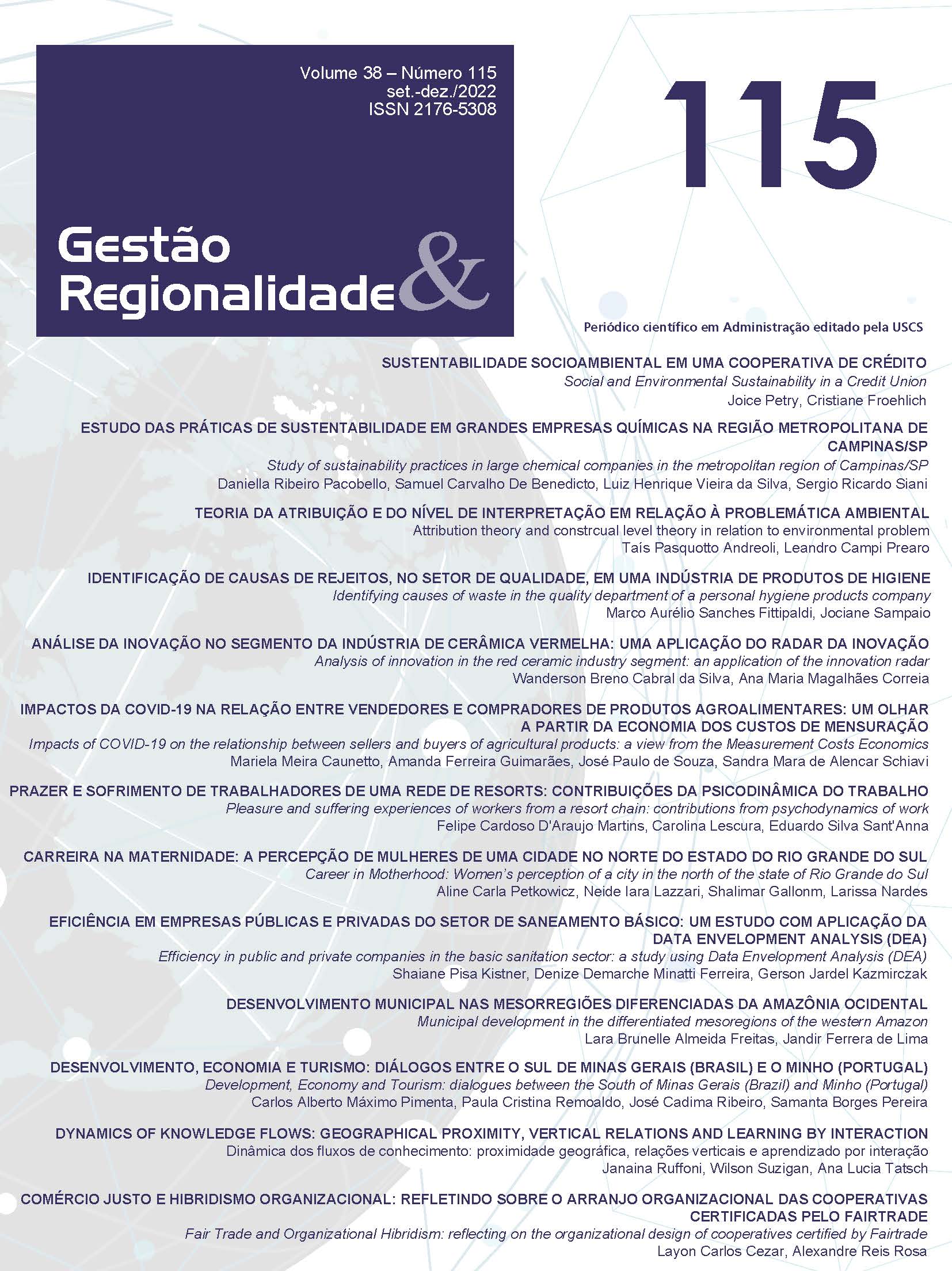
COMÉRCIO JUSTO E HIBRIDISMO ORGANIZACIONAL: Refletindo sobre o arranjo organizacional das cooperativas certificadas pelo Fairtrade
DOI:
https://doi.org/10.13037/gr.vol38n115.7645Palabras clave:
Comércio Justo, Organizações Híbridas, CooperativasResumen
O objetivo deste estudo é compreender como os mecanismos da certificação Fairtrade influenciam no arranjo organizacional das cooperativas enquanto organizações híbridas. Fundamentando no hibridismo organizacional como base teórica, o estudo se guia pelas contribuições dos estudiosos interpretativistas de gestão, que consideram as cooperativas como organizações sociais híbridas. Esta investigação estrutura-se como uma pesquisa qualitativa, de caráter exploratório, realizada a partir de um estudo de caso em uma cooperativa de cafeicultores Fairtrade do Espírito Santo. Como instrumento de coleta de dados foi utilizada da triangulação de técnicas, por meio de entrevista semiestruturada, observação não participante e documentos, analisados a partir da análise de conteúdo. Os principais resultados apontaram a necessidade de forjar o arranjo da cooperativa ao desenho do Fairtrade, para se adequar aos instrumentos normativos, criando mecanismos de governança específicos para evitar a perda de legitimidade.
Descargas
Referencias
AUDEBRAND, L. K. Expanding the scope of paradox scholarship on social enterprise: the case for (re)introducing worker cooperatives. M@n@gement, v. 20, n. 4, p. 368, 2017.
BACON, C. Confronting the coffee crisis: Can Fair Trade, organic, and specialty coffees reduce small-scale farmer vulnerability in Northern Nicaragua? World Development, v. 33, n. 3, p. 497-511, 2005.
BATTILANA, J. Agency and Institutions: The Enabling Role of Individuals' Social Position. Organization, v. 13, n. 5, p. 653-676, 17 set. 2006.
______. Harnessing productive tensions in hybrid organizations: The case of work integration social enterprises. Academy of Management Journal, v. 58, n. 6, p. 1658-1685, 2015.
BATTILANA, J.; CASCIARO, T. Overcoming Resistance to Organizational Change: Strong Ties and Affective Cooptation. Management Science, v. 59, n. 4, p. 819-836, abr. 2013.
BATTILANA, J.; DORADO, S. Building Sustainable Hybrid Organizations: The Case Of Commercial Microfinance Organizations. Academy of Management Journal, v. 53, n. 6, p. 1419-1440, 2010.
BATTILANA, J.; LECA, B.; BOXENBAUM, E. 2 How Actors Change Institutions: Towards a Theory of Institutional Entrepreneurship. The Academy of Management Annals, v. 3, n. 1, p. 65-107, jan. 2009.
BATTILANA, J.; LEE, M. Advancing Research on Hybrid Organizing - Insights from the Study of Social Enterprises. Academy of Management Annals, v. 8, n. 1, p. 397-441, 2014.
BEJI-BECHEUR, A.; DIAZ PEDREGAL, V.; OZCAGLAR-TOULOUSE, N. Fair trade - Just how "fair" are the exchanges? Journal of Macromarketing, v. 28, n. 1, p. 44-52, 2008.
BOSSLE, M. B. et al. Fair trade in Brazil: current status, constraints and opportunities. Organizações & Sociedade, v. 24, n. 83, p. 655-673, 2017.
BRFAIR. A BRFAIR. Disponível em: <http://brfair.com.br/a-brfair>. Acesso em: 20 maio 2019.
CHU, R. A.; WOOD JR., T. Brazilian cultural organization in post-globalization: global or local? Revista de Administração Pública, v. 42, n. 5, p. 969-991, 2008.
CLAC. Apresentação da Rede Café. Disponível em: <http://clac-comerciojusto.org/pt-br/redes-y-productos/redes-de-producto/rede-cafe/>. Acesso em: 20 maio 2019.
______. Cálculo de preços do comércio justo. Disponível em: <http://clac-comerciojusto.org/wp-content/uploads/2015/04/Cálculo-de-Preços-Comércio-Justo-ok.pdf>. Acesso em: 4 fev. 2020.
COTERA, A.; ORTIZ, H. Comércio Justo. In: ANTONIO DAVID CATTANI et al. (Org.). . DicionaÌrio Int. da outra Econ. Coimbra: Almedina, 2009. p. 344.
DIMITRIADIS, S. et al. Blurring the Boundaries: The Interplay of Gender and Local Communities in the Commercialization of Social Ventures. Organization Science, v. 28, n. 5, p. 819-839, out. 2017.
EBRAHIM, A.; BATTILANA, J.; MAIR, J. The governance of social enterprises: Mission drift and accountability challenges in hybrid organizations. Research in Organizational Behavior, v. 34, p. 81-100, 2014.
FAIRTRADE. Fairtrade International (FLO): History of Fairtrade. Disponível em: <https://www.fairtrade.net/about-fairtrade/history-of-fairtrade.html>. Acesso em: 16 maio 2019.
FLICK, U. Qualidade na pesquisa qualitativa: coleção pesquisa qualitativa. Porto Alegre: Bookman Editora, 2009.
FLOCERT. A FLOCERT apoia negócios sustentáveis e está tornando o comércio global mais justo. Disponível em: <https://www.flocert.net/pt/>. Acesso em: 16 maio 2019.
FRIDELL, M.; HUDSON, I.; HUDSON, M. With friends like these: The corporate response to fair trade coffee. Review of Radical Political Economics, v. 40, n. 1, p. 8-34, 2008.
GEIGER-ONETO, S.; ARNOULD, E. J. Alternative trade organization and subjective quality of life: The case of latin american coffee producers. Journal of Macromarketing, v. 31, n. 3, p. 276-290, 2011.
HAIGH, N. et al. Hybrid Organizations: Origins, Strategies, Impacts, and Implications. California Management Review, v. 57, n. 3, p. 5-12, 2015.
HUDSON, I.; HUDSON, M. Removing the veil? Commodity fetishism, fair trade, and the environment. Organization and Environment, v. 16, n. 4, p. 413-430, 2003.
KHAREL, A.; MIDDENDORF, G. Is Fair Trade 'Fair'? A Study of Handmade Paper Producers in Nepal. Journal of Land and Rural Studies, v. 3, n. 2, p. 253-273, 2015.
LECA, B.; GOND, J. P.; BARIN CRUZ, L. Building 'Critical Performativity Engines' for deprived communities: The construction of popular cooperative incubators in Brazil. Organization, v. 21, n. 5, p. 683-712, 2014.
LEE, C. et al. How the Zebra Got Its Stripes : Imprinting of Individuals and Hybrid Social Ventures. Harvard Business School Working Paper, v. 14, n. 005, 2013.
LEE, M.; JAY, J. Strategic Responses to Hybrid Social Ventures. California Management Review, v. 57, n. 3, p. 126-147, 2015.
LEVI, M.; LINTON, A. Fair trade: A cup at a time? Politics and Society, v. 31, n. 3, p. 407-432, 2003.
MARQUIS, C.; BATTILANA, J. Acting globally but thinking locally? The enduring influence of local communities on organizations. Research in Organizational Behavior, v. 29, p. 283-302, 2009.
MIRANDA, B. V.; SAES, M. S. M. Coordenação e Qualidade no Sistema Fairtrade: o exemplo do café. Organizações Rurais & Agroindustriais, v. 14, n. 3, p. 367-379, 2012.
OCASIO, W.; THORNTON, P. H.; LOUNSBURY, M. The Institutional Logics Perspective. In: GREENWOOD, R. et al. (Org.). . SAGE Handb. Organ. Institutionalism. 2. ed. [S.l.]: SAGE Publications, Inc., 2017. p. 928.
OLIVEIRA, R. F. de; ARAÚJO, U. P.; SANTOS, A. C. dos. Efeito do Fair Trade na cooperativa de agricultores familiares de café de Poço Fundo, MG. Organizações Rurais & Agroindustriais, v. 10, n. 2, p. 211-225, 2008.
PARANQUE, B.; WILLMOTT, H. Cooperatives—saviours or gravediggers of capitalism? Critical performativity and the John Lewis Partnership. Organization, v. 21, n. 5, p. 604-625, 2014.
RAYNOLDS, L. T.; MURRAY, D.; TAYLOR, P. L. Fair Trade coffee: Building producer capacity via global networks. Journal of International Development, v. 16, n. 8, p. 1109-1121, 2004.
SCHMELZER, M. Marketing morals, moralizing markets: Assessing the effectiveness of fair trade as a form of boycott. Management and Organizational History, v. 5, n. 2, p. 221-250, 2010.
SIGGELKOW, N. Persuasion with case studies. Academy of Management Journal, v. 50, n. 1, p. 20-24, 2007.
SONPAR, K.; GOLDEN-BIDDLE, K. to Elaborate Adolescent Theories of Organization. Organizational Research Methods, v. 11, n. 4, p. 795-814, 2008.
VAIL, J. Decommodification and Egalitarian Political Economy. Politics & Society, v. 38, n. 3, p. 310-346, 24 set. 2010.
VÁSQUEZ-LEÓN, M. Free Markets and Fair Trade, Collective Livelihood Struggles, and the Cooperative Model. Latin American Perspectives, v. 37, n. 6, p. 53-73, 2010.
WOOD JR., T. Organizações híbridas. Revista de Administração de Empresas, v. 50, n. 2, p. 241-247, 2010.
YIN, R. K. Estudo de Caso. Porto Alegre: Bookman, 2003.
Descargas
Publicado
Número
Sección
Licencia
Derechos de autor 2022 Layon Carlos Cezar, Alexandre Reis Rosa (Autor)

Esta obra está bajo una licencia internacional Creative Commons Atribución-NoComercial-SinDerivadas 4.0.
Autores que publicam nesta revista concordam com os seguintes termos:
- Autores mantém os direitos autorais e concedem à revista o direito de primeira publicação, com o trabalho simultaneamente licenciado sob a https://creativecommons.org/
licenses/by-nc-nd/4.0/, permitindo o compartilhamento do trabalho com reconhecimento da autoria do trabalho e publicação inicial nesta revista. - Autores têm autorização para assumir contratos adicionais separadamente, para distribuição não-exclusiva da versão do trabalho publicada nesta revista (ex.: publicar em repositório institucional ou como capítulo de livro), com reconhecimento de autoria e publicação inicial nesta revista.
- Autores têm permissão e são estimulados a publicar e distribuir seu trabalho online (ex.: em repositórios institucionais ou na sua página pessoal) a qualquer ponto antes ou durante o processo editorial, já que isso pode gerar alterações produtivas, bem como aumentar o impacto e a citação do trabalho publicado (Veja O Efeito do Acesso Livre).